


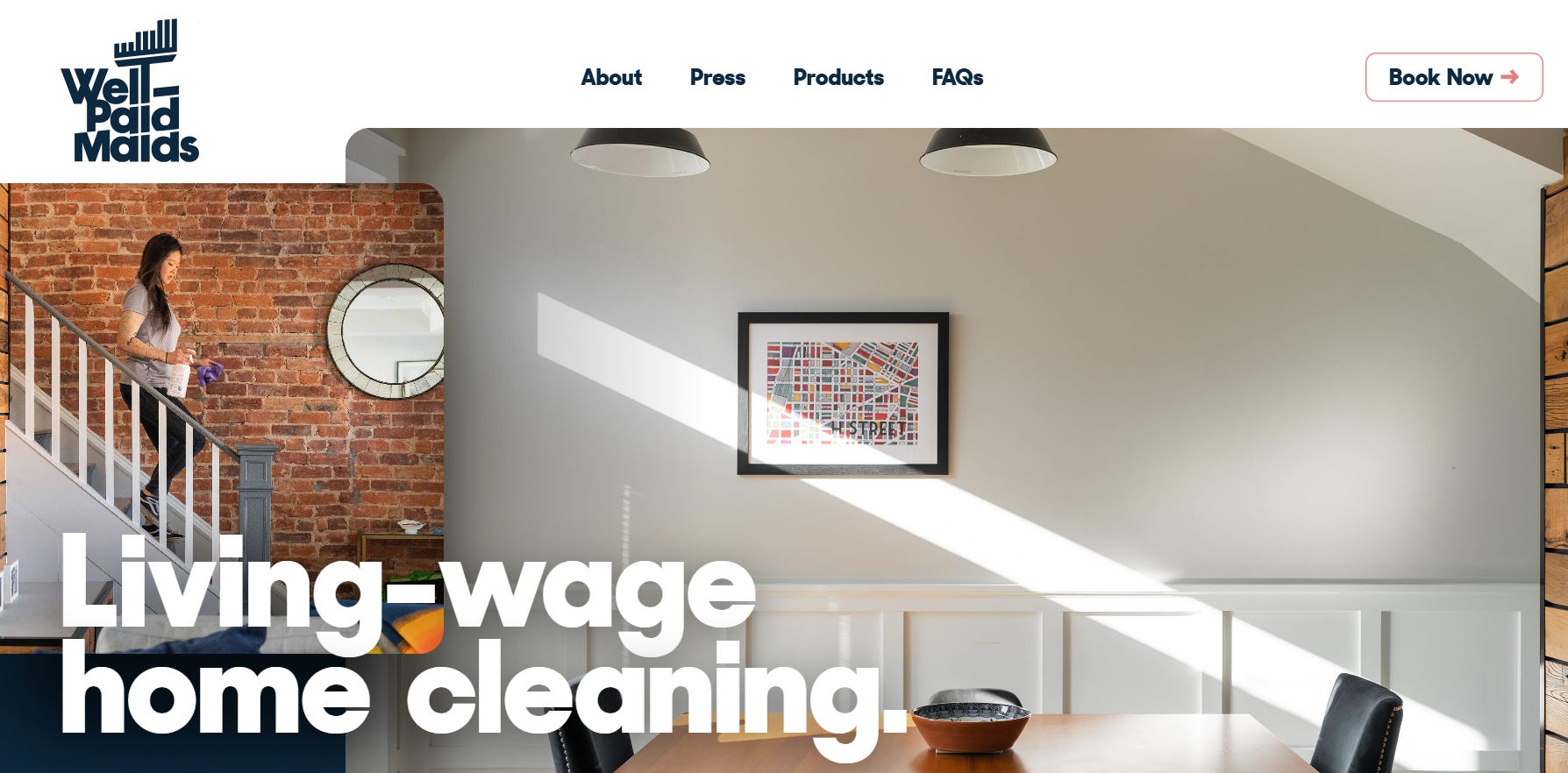
My name is Aaron Seyedian and I’m the owner of Well-Paid Maids, a living-wage home cleaning company that operates in Washington, DC, New York City, Chicago, Los Angeles, and San Francisco.

I founded the business in 2017 and have about 75 employees. The company has delivered almost 50,000 cleanings to date and it will be opening in Denver, Seattle, and Boston this year. All my staff make at least $26 per hour and receive a full benefits package including 24 paid days off per year and health, dental, and vision insurance. We are accredited by Living Wage for US, the country’s only national living-wage accreditation body.
Many factors influenced my decision to start a business. But one thing that meaningfully nudged me in this direction was reading small business features in The Washington Post when I was in my 20s. At the same time that I was learning what it meant to be an employee, I was reading a steady stream of stories about people who quit their jobs to do their own thing.
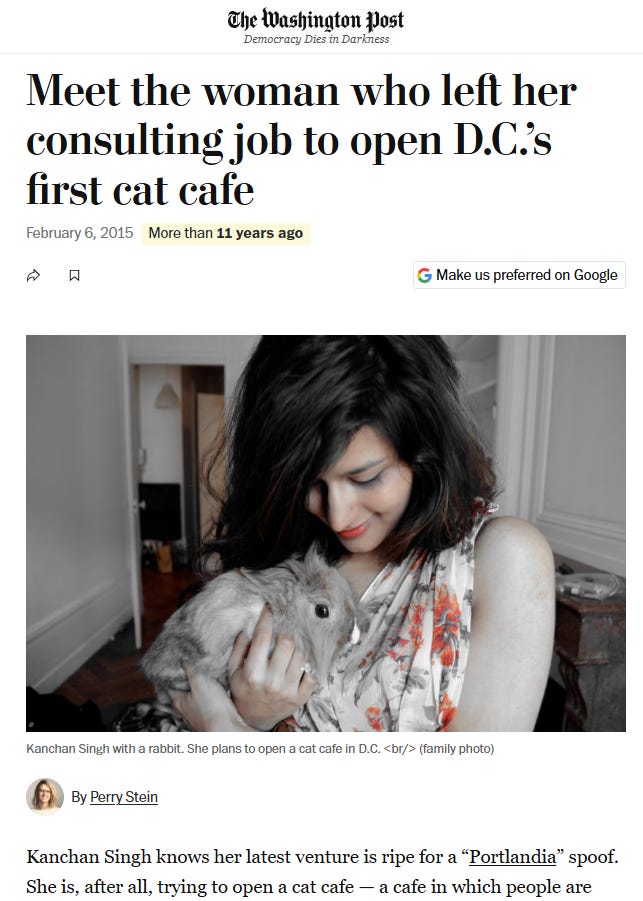
I remember reading about the city’s first cat cafe, Crumbs & Whiskers, in 2015. I admired the woman, Kanchan Singh, who left her consulting job to start it. And I was interested in all the hiccups she experienced along the way.
After the initial story, I was able to keep reading about her business in the Post:
I even got to see the initial set of cats in a video feature. In addition, the Post profiled two different competitors (2015, 2019) in features that explained what differentiated these cat cafes from Crumbs & Whiskers. In all, that’s eight stories touching on a single small business over five years.
Unfortunately, you can’t read The Washington Post to learn about local businesses today. Their last small business reporter, Tom Heath, retired in 2021, and given what’s been happening at the Post, I think it’s safe to say this format is mostly dead in the DC area, save for the Washington Business Journal’s weekly small business profile.
While I don’t read every media outlet in the country, I do familiarize myself with the media landscape of each geography my company operates in, and it seems like the decline of this format in my area’s paper of record is mirrored everywhere.
In its place is a vast library of extremely shallow content about entrepreneurship via podcasts and video. This content ostensibly prepares listeners to start their own companies, but it contains so little practical information about running a business that it’s hard to see the utility. It’s also heavily focused on tech startups, a type of business that 99.9% of people are not going to create.
The entrepreneurship beat at large has been almost totally reduced to the worst qualities that were already prevalent in its final form in written legacy media — narrative interviews about the business’s journey, a dearth of hard numbers, an absence of fact checking, and an overemphasis on the founder’s personal growth over how the business actually functions.
I think there is a better way to profile small businesses, which is why I started this site. It begins with asking business owners to share their income statements ahead of an interview. Working backward from the profit and loss statements, I believe, will automatically:
Anchor the conversation in hard numbers
Produce a ground truth that’s usable for fact checking
Demonstrate how the business functions and makes money
Why has no one done this before? It’s seen as a big ask. It's taboo. Most private business owners are not going to make their income statements public. My bet? Some will, and that will be enough.
If this works, I think it will be a new kind of content that’s not available anywhere else. There are some online clearinghouses that model this kind of stuff, but it’s not the same as looking at the real books of a given company. Sometimes, financial statements can surface in legal documents from a bankruptcy or divorce, but that’s not available on demand.
Of course, you can dig into public companies all you want, but that’s only .01% of companies in the United States. I want to see how much a nail salon in Long Beach spends on polish. I want to know how expensive workers’ compensation insurance is for a pizza place in Iowa City. I want to learn how profitable it is to operate an oyster farm on the Eastern Shore of Maryland. This is the kind of stuff you’ll never get in a 10-K.
Let’s see if it works. If I do it well, it should be a useful resource for aspiring entrepreneurs and business school students, existing business owners, and folks looking to acquire or invest in private companies.
I’ll be paying each owner for the right to publish their documents, and plan to revisit posts in future years to do updates. The dream scenario for this project is that five years from now, it has morphed from a newsletter, to a media site, to a case database of sorts, where users can filter on industry, size, and geography to access evergreen, longitudinal financial data and supporting context for hundreds of private businesses.
I’ll start by publishing one article per week, and I’ll kick it off next week with my own business, Well-Paid Maids. If you’re interested in being interviewed, please email aaron@theincomestatements.com.